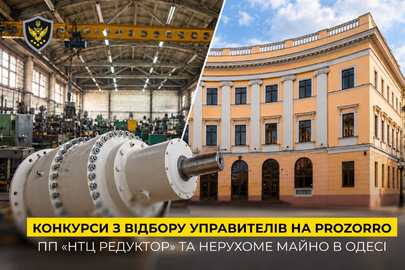
The Asset Recovery and Management Agency continues to implement court ruling regarding the management of the assets of the IDS Ukraine group in accordance with applicable legislation and open procedures.
ARMA emphasizes that once assets are seized, the state is obliged to ensure their proper management. The law does not provide for alternative scenarios: leaving an asset without management entails the risk of financial manipulation, downtime, depreciation, or loss of economic value. This is precisely why ARMA performs the function defined by law - organizing asset management in the interests of the state and society.
How the Asset Management Tender Is Organized
The selection of a manager for the IDS Ukraine assets is carried out through the Prozorro electronic procurement system - openly, publicly, and with equal access for all market participants. The tender conditions are published in advance, the criteria are uniform for all bidders, and each stage of the procedure is recorded in a public digital environment.
Current legislation provides that ARMA first conducts preliminary market consultations and announces a tender to find a manager, and only after the winner is determined are the assets actually transferred for management under acceptance and transfer acts. All Agency tenders are conducted in accordance with this procedure.
Announcing a tender prior to the actual transfer of the assets does not constitute a violation; on the contrary, it ensures continuity of management and prevents downtime or loss of asset value.
On the Tender Conditions and Requirements for Participants
The tender documentation does not contain requirements tailored to specific companies or a narrow circle of participants. Potential managers may demonstrate experience in any of the specified areas - production or sale of products or beverages, water supply, or property management. This approach does not create advantages for any particular category of business.
In addition, all participants undergo verification of financial capacity, transparency of ownership structure, and business reputation. The purpose of these requirements is not to restrict competition, but to ensure that a strategically important asset is managed professionally and responsibly.
On the Information Pressure Surrounding the Tender
At the same time, the Agency has noted an increase in public statements and materials aimed at discrediting the competition. The reason for this pressure is obvious: for years, the assets of the IDS Ukraine group were under the de facto control of individuals who derived significant income from them. Transferring the assets to state management means losing this control, which explains the resistance and attempts to influence the process in the public sphere. We recall that these assets are linked to sanctioned russian individuals, including Mikhail Fridman, who is subject to sanctions imposed by Ukraine, the European Union, the United States, the United Kingdom, and Canada due to his support for the russian regime and threats to international security.
The use of procedural mechanisms in the public domain should not replace the legal process or influence perceptions of the lawfulness of the Agency’s actions prior to the adoption of relevant court decisions.
ARMA acts consistently and transparently, ensuring the preservation of the economic value of assets, preventing their downtime or depreciation, engaging professional managers on a competitive basis, and ensuring accountability at every stage of the procedure.
The management of seized assets is not a matter for debate or manipulation, but a direct obligation of the state, which ARMA fulfills within the law, publicly and under institutional oversight.
OTHER MATERIALS


10-10-2026 News